

Despite recent disruption in search, SEO remains one of the most effective ways to attract qualified B2B buyers.
According to Ahrefs SEO provides a 702% average ROI for B2B companies – and Google sends 345 times more traffic to websites than ChatGPT, Gemini, and Perplexity combined.
For B2B SaaS companies, a strong organic growth strategy is still essential.
But it needs to be:
I built and sold a SaaS business after surpassing £1M in revenue, using SEO as the primary growth channel, and while the landscape has shifted in recent years, the fundamentals haven’t.
This is my high-level strategy guide for B2B Saas leaders to grow signups and revenue with SEO.
1. SEO’s role in B2B SaaS
And what’s changed in 2026
2. B2B Keyword research
Targeting your ideal clients at the right time
3. Content creation
Build pages that convert leads at scale
4. Link building
Boost your sites authority to compete with the big boys
5. Technical SEO
Ensure search engines crawl and index your content
Why SEO is important for B2B SaaS
And what’s changed in 2026
Here’s why it’s more important than ever for B2B brands to invest in SEO, and how recent changes in search are reshaping the opportunity.
Drastically reduce customer acquisition costs
Paid acquisition costs continue to rise across Google Ads and LinkedIn, making efficient growth harder for B2B SaaS brands.
SEO allows you to attract buyers already searching for solutions without paying for every click.
Once content is created and rankings are established, traffic can continue for months or years with almost negligible costs, compared to paid media.
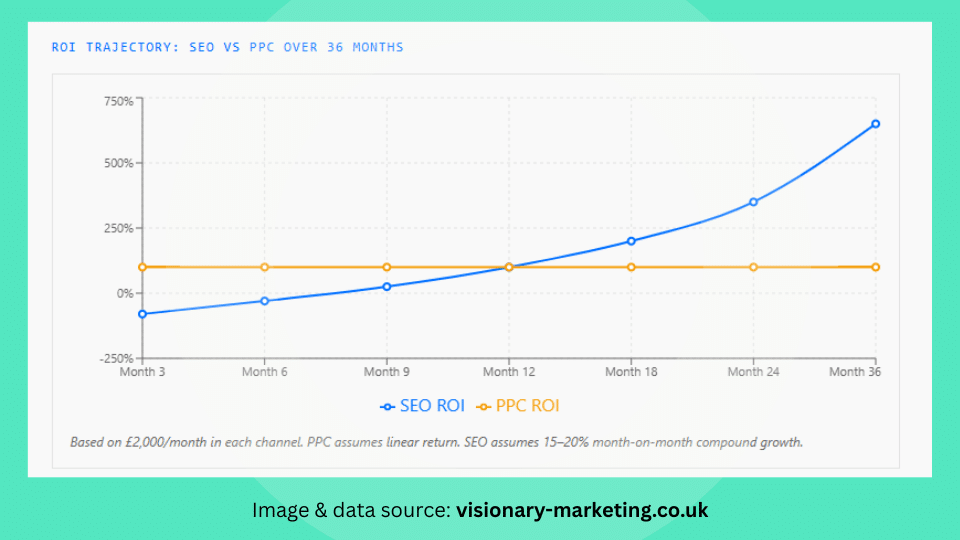
A recent study from Visionary found that SEO delivers a 3.7x higher ROI than PPC.
Build a moat and increase company valuation
Strong SEO turns a website into a valuable digital asset that competitors cannot replicate overnight.
High-ranking commercial pages, trusted backlinks, and consistent inbound demand can take years to build, but once established, they are difficult to displace.
Businesses with predictable, diversified acquisition channels are more attractive to buyers and investors than those reliant on paid ads alone.
When I sold my SaaS business in March 2026, organic traffic was the number one priority for almost every buyer.
Build trust at every stage of the buying journey
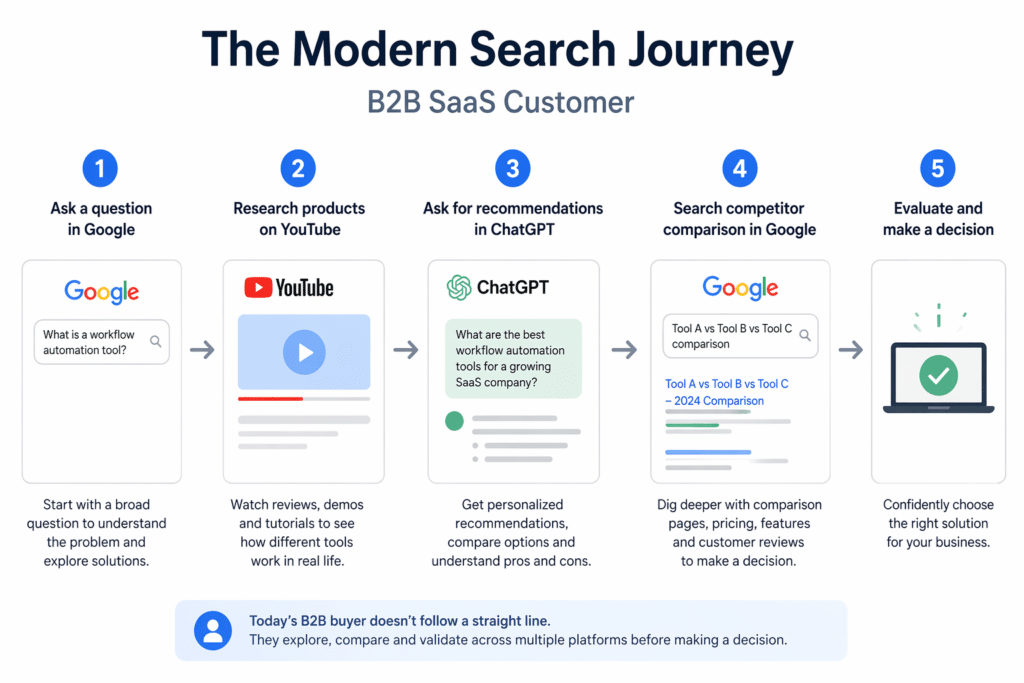
B2B buyers rarely purchase after a single touchpoint.
They research problems, compare providers, read reviews, and revisit brands multiple times before booking a demo.
Good SaaS SEO helps your company appear throughout that journey with useful content, comparison pages, case studies, and solution pages – without paying for every click.
What’s changed in organic search?
There are 2 key changes that B2B marketers need to be aware of:
B2B brands need AI search visibility
In 2026 SEO is no longer just about ranking in Google
Organic visibility now extends into AI overviews and LLM tools like ChatGPT
So when a potential client asks an AI tool “what is the best software for [Your solution]” – your brand needs to show up.
Informational web content has lost its impact
With many informational queries now being answered directly inside LLMs, and users becoming increasingly sceptical of companies publishing masses of poor-quality AI-generated content at scale, informational content is driving fewer clicks to websites.
It still plays an important role in building topical authority and nurturing prospects, but it is no longer the high-volume lead driver it once was for many B2B businesses.
Keyword research
Targeting your ideal clients at the right time
Keyword research is simply understanding what terms your ideal customers search for, when they need a solution like yours.
SaaS teams who fail to carry out proper keyword research, often waste time creating content that adds no value to their business.
Know your ICP inside-out
The first step in any successful SEO campaign (or arguably any marketing activity) is to understand who your ideal clients are, and what their problems are.
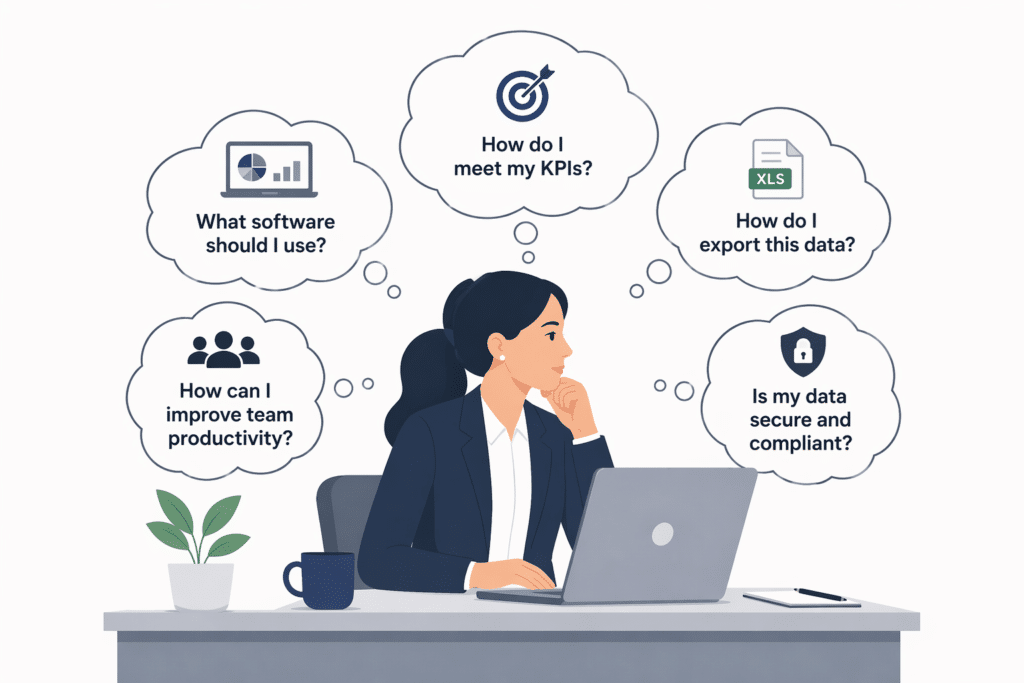
For a B2B product you need to understand your client’s job completely.
All of your content can then be shaped around how your product helps them to solve these problems.
If you feel that you don’t have a deep enough understanding of your clients, I have a more detailed breakdown of how to build your ICP within my full SaaS SEO guide.
SaaS SEO moves fast. Don’t get left behind
Follow me on LinkedIn to see what’s working this week, not last year.

Build keyword lists mapped to the customer journey
Once you know who your ideal client is – it’s time to turn their questions into keywords.
You probably already have a good idea of some typical queries your clients have, but it’s best to collect them directly from your prospects and clients.
Some good places to gather profitable keyword ideas are:
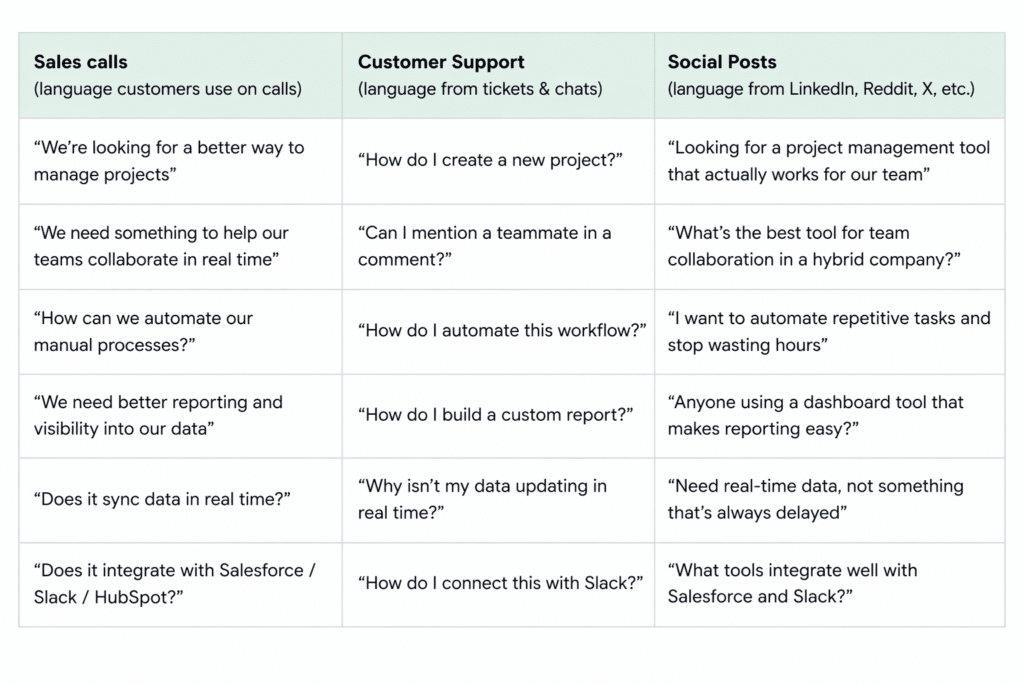
You can automate some of this by recording sales calls with a tool like Avoma, or using scraping tools to extract social post data.
But simply asking your team to add questions to a shared sheet as they go about their day job – is a solid way of collecting valuable keywords.
Mapping keywords to the sales funnel
Once you’ve built a substantial list of keywords – map them to the sales funnel, to understand where they fit into the customer journey.
| Buyer stage | Stage description | Example questions | Best content types |
|---|---|---|---|
| Top of funnel (awareness) | Buyers know they have a problem and are researching possible solutions. | How can I automate invoice reminders? How do SaaS companies reduce churn? How to integrate my CRM with Google Sheets? | Guides, educational articles, industry reports, templates, checklists |
| Middle of funnel (consideration) | Buyers understand the category and are comparing options, features, and vendors. | Best invoicing software for small businesses CRM with automated lead scoring Project management software for remote teams | Use-case pages, feature pages, case studies, comparison articles, alternatives pages |
| Bottom of funnel (decision) | Buyers are close to purchase and evaluating specific providers before making a final decision. | Accounting Software Best ClickUp alternative for agencies Best proposal software for agencies | Product landing pages, pricing pages, competitor vs pages, integration pages, testimonials, free trial/demo pages |
Record them in a simple spreadsheet.
Prioritise content with the highest value
SEO’s biggest perceived drawback is the time it takes to see results
That concern is understandable – especially for SaaS companies under pressure to grow MRR with limited time and resources.
But SEO does not have to take forever. When you prioritise the right keywords, it can start generating qualified leads within weeks rather than months.
Here’s how we approach keyword prioritisation at LinkQuest to help clients see ROI faster.
Focus on BOF and MOF keywords
Top of funnel guides are great for building topical authority, brand awareness and building trust with users, but they don’t drive quick conversions.
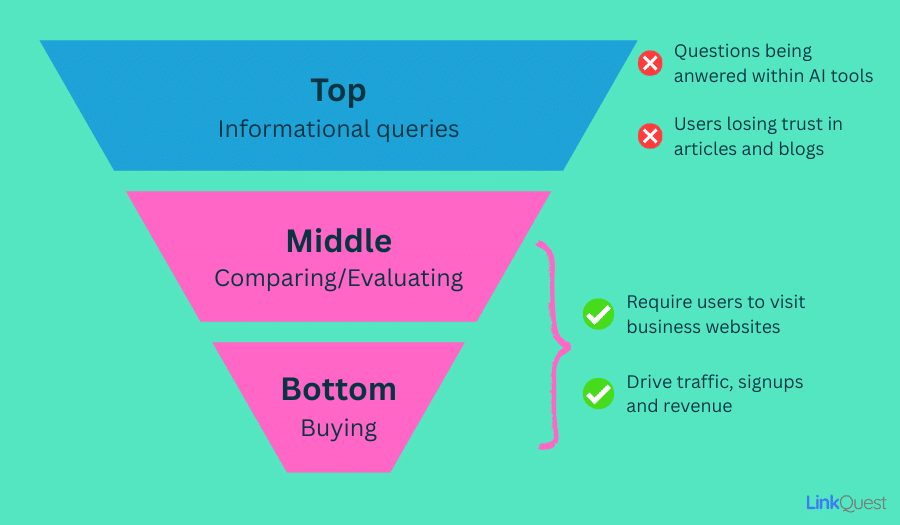
Focusing on middle and bottom funnel keywords early, will attract prospects who are much closer to making a purchase – and start driving signups as soon as the content is ranking.
From growing my own SaaS business and working with clients, I’ve found that the majority of organic revenue is typically driven by these 6 SaaS SEO content types:
You’ll likely find that most of your MOF and BOF keywords fall into one of these categories.
These are keywords that you should attack first if you want to see returns quickly.
Calculate potential revenue
At LinkQuest (Our SEO agency) we like to understand the revenue potential of a keyword before investing resources into content creation.
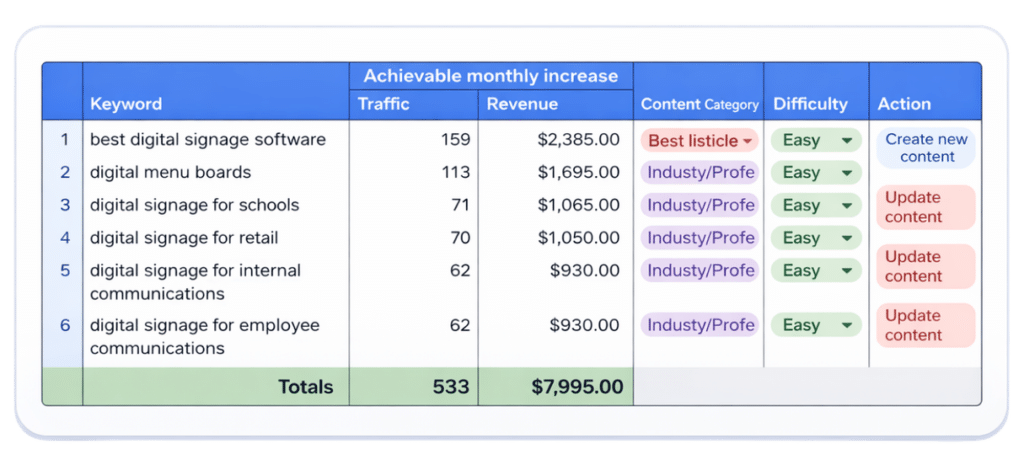
Our process is thorough, so you may not need to follow every step exactly – but you should at least have some way to estimate how valuable a keyword could be to your business.
We grab the following data for each keyword from Ahrefs:
And we combine them with following figures from the business:
This allows us to model the potential traffic increase and booked revenue uplift from each keyword, like the example below.
This gives us a clear picture of which keywords will provide the most value to the business, so resources can be focused where they will have the biggest impact.
For more detail on how we approach these calculations, check out our free 90 day SEO revenue plan.
Attack low competition keywords first.
At this stage it’s tempting to schedule content for all of the keywords with the highest earning potential.
Don’t.
You have to balance revenue-potential with achievability.
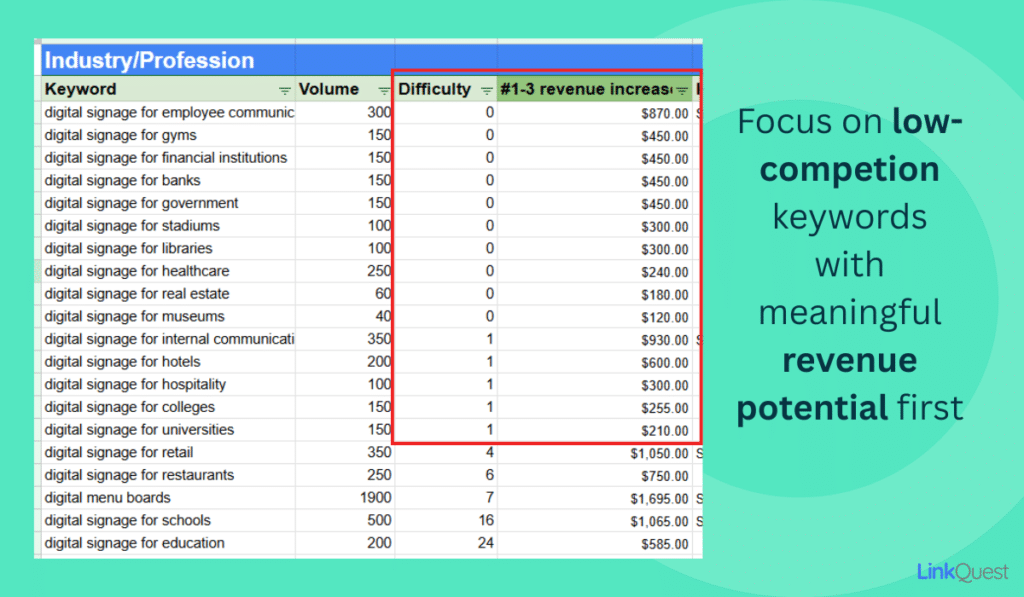
Many of the most valuable keywords will have very high levels of competition, meaning that it will be almost impossible to rank for them in the short term.
Instead, start with keywords that have meaningful revenue potential, where you stand a good chance of ranking quickly.
To determine your chances of ranking your content for a particular keyword use the following factors:
Create a content schedule
Once you’ve identified a handful of low-competition revenue-generating keywords – create a simple publishing schedule.
Focus on quality over volume.
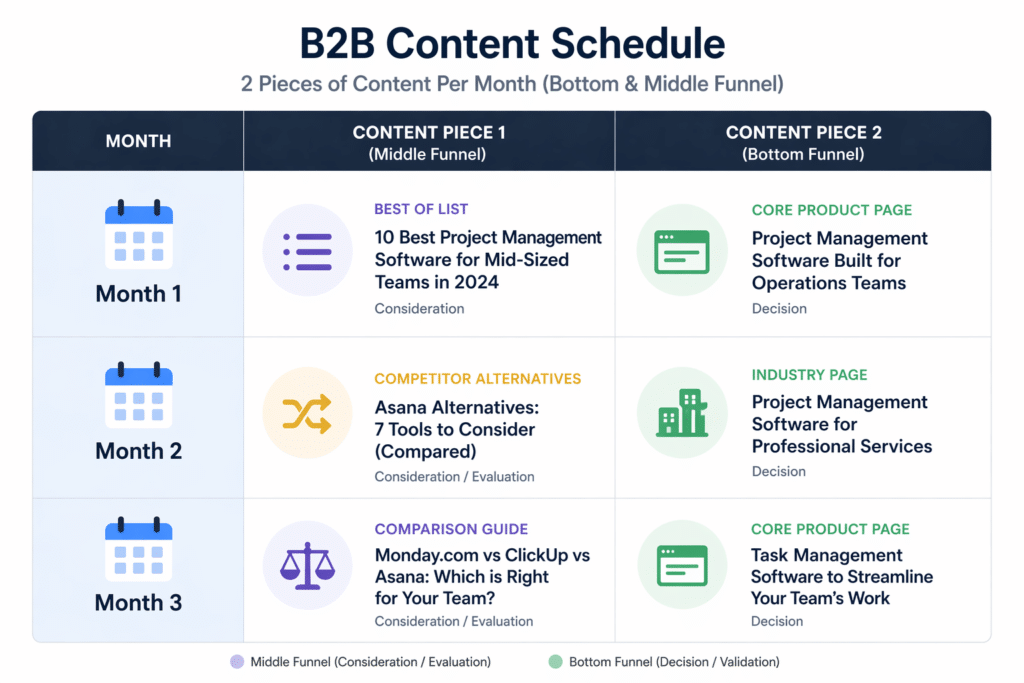
One or two high-quality pieces of high-intent content each month will usually outperform 20 rushed, low-value, or purely AI-generated articles.
As your strategy progresses, your site authority grows and SEO returns compound. That allows you to gradually target more competitive keywords and expand into larger opportunities over time.
Content creation
Attract and convert leads at scale
A high-quality content asset can attract qualified leads for months or even years.
But for content to rank and convert, it needs to beat competing pages by miles.
Achieving this requires a structured approach.
Analyse the competition
Before creating any page, study what already ranks. Google has already shown you what it believes satisfies the query, so use that as your benchmark, then improve on it… vastly
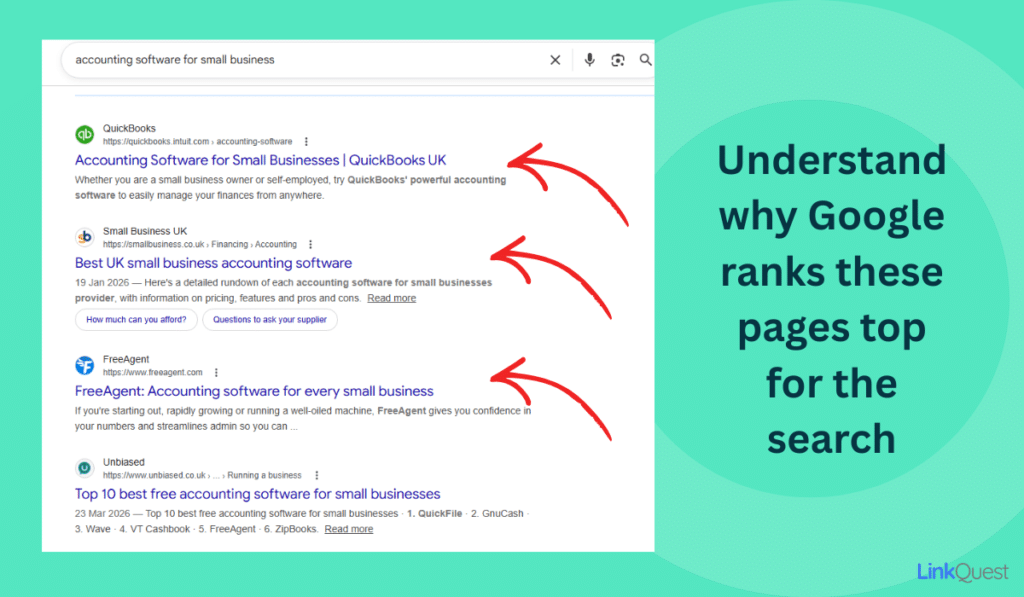
Look for:
Understand the search intent
Search intent is the reason behind the query. If your page does not match what the user wants, it is unlikely to rank or convert well.
Someone searching “best CRM for startups” wants comparisons. Someone searching “CRM Someone searching “how to improve sales pipeline” wants education.
To determine intent:
Match the intent first, then improve the experience.
Create amazing content
In 2026, average content is becoming invisible. AI tools can summarise generic information instantly, so users need a real reason to visit your website.
Search engines also reward pages that satisfy users better than the alternatives.
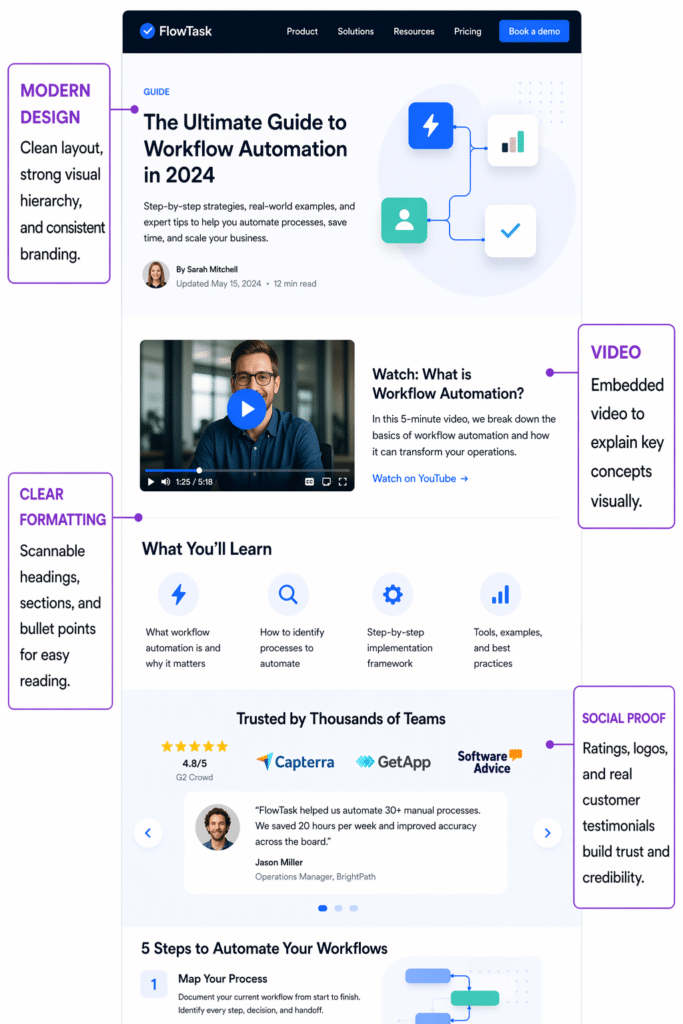
Your content should aim to be genuinely better through:
Add strong tailored CTAs
Traffic alone does not grow a SaaS business.
Conversions do.
Every page should give visitors an obvious next step based on where they are in the buying journey.
For example:
Make CTAs relevant to the page topic, visible throughout the content, and friction-free to use.
Get the 90-Day SaaS SEO Revenue Plan
A proven framework for SaaS teams who need to drive organic MRR fast
Link building
Boost your sites authority to compete with the big boys
Despite ongoing claims that link building is “dead”, backlinks remain one of the most important ranking signals in SEO. Recent studies from Semrush, Ahrefs and Backlinko continue to support this.
When reputable websites link to your content, it signals to search engines that your site is trustworthy and authoritative.
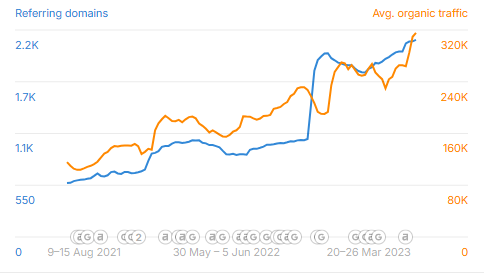
However, quality and relevance matter far more than volume.
A small number of links from respected, relevant websites can have far more impact than hundreds of low-quality links.
Link building is also one of the most difficult parts of SEO, which is why many companies get it wrong, see weak results, and eventually abandon it.
Over the past five years, I’ve primarily used the following link building strategies at StandOut CV and for SaaS client websites.
| Tactic | Brief description | Difficulty | Link Quality | Scalability | Cost |
|---|---|---|---|---|---|
| Existing partnerships | Secure links from suppliers, integrations, clients, technology partners, and other commercial relationships. | Low | High | Medium | Low |
| Guest articles | Publish expert-led content on relevant industry websites in exchange for exposure and backlinks. | Medium | Medium to High | Medium | Low to Medium |
| Podcast guest appearances | Appear on podcasts and earn links from show notes while building brand visibility and authority. | Medium | Medium to High | Medium | Low |
| Linkable assets | Create tools, research, templates, calculators, or useful resources that attract links naturally over time. | High | High | High | Medium to High |
| Digital PR | Run campaigns, stories, or data-led outreach to earn coverage and backlinks from major publications. | High | Very High | Medium to High | High |
Existing partnerships
Suppliers, integrations, technology partners, and other business relationships can often create natural opportunities for relatively low-effort backlinks. Most marketing teams will be open to the idea of reciprocal linking where there is a genuine need for it.
Podcast and interview appearances
Appearing on podcasts and other interviews can earn backlinks from relevant sites, while also helping to build brand awareness and credibility. I’ve used this tactic at LinkQuest, doing interviews for SaaS websites such as Indie Hacker.
Linkable assets
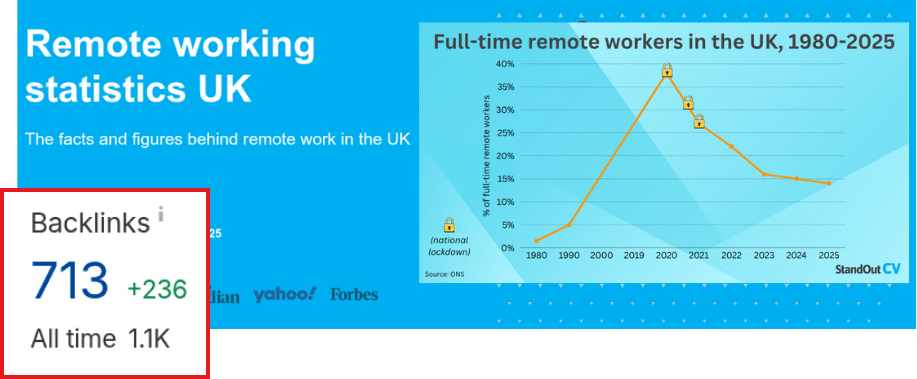
Tools, original research, data studies, and useful resources can attract links naturally over time, without the need for manual outreach. We used linkable assets to generate thousands of high-quality backlinks at StandOut CV at a very low cost.
Digital PR
For more established companies with larger budgets, digital PR campaigns create interesting stories from company insights and pitch them to media outlets. These campaigns can secure backlinks from major publications at scale when done correctly.
Guest articles
Publishing content on industry websites can generate valuable backlinks and increase brand visibility. Founder stories, lessons learned, and case studies often perform especially well in the SaaS space.
Existing partnerships and interviews are probably the easiest tactic for businesses who are new to SEO , so stick with them in the early days.
Link building can be time consuming so focus on building a manageable amount of quality links each month, and don’t chase volume.
Technical SEO
Ensure search engines crawl and index your content
Technical SEO ensures search engines can efficiently crawl, understand, and index your website.
Even the best content can struggle to rank if pages are slow, broken, duplicated, or difficult to access.
For B2B SaaS websites, strong technical foundations are essential.
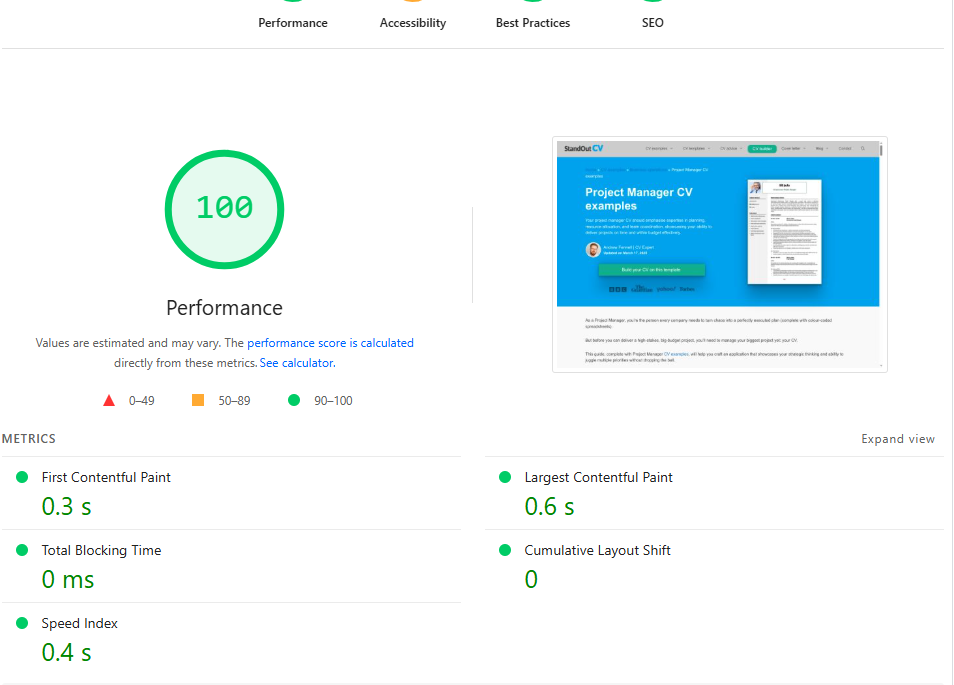
Key actions:
The B2B SaaS SEO playbook for 2026
SEO remains one of the most profitable growth channels for B2B SaaS companies – but the rules have changed. Informational content alone is no longer enough, as AI tools answer more queries directly and competition for attention increases.
The winners in 2026 will focus on high-intent commercial content, strong technical foundations, authoritative backlinks, and content experiences that genuinely outperform competitors. Brands that build visibility across Google, AI search, and other discovery platforms will generate lower-cost leads, stronger pipelines, and long-term growth.
Get the 90-Day SaaS SEO Revenue Plan
A proven framework for SaaS teams who need to drive organic MRR fast